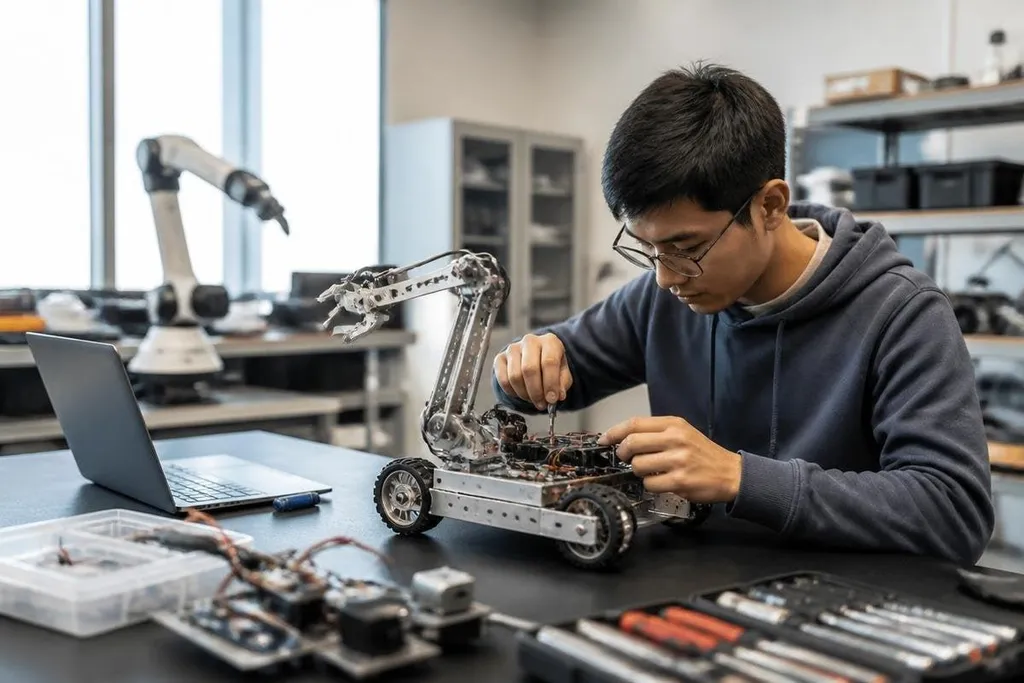
A robotics engineer turns code, sensors, motors, and mechanical parts into a system that can do useful work. The job can involve designing a gripper, writing motion control software, testing a mobile robot, or fixing a fault that only appears after hours of operation.
The path is broad, but the work has a clear pattern: learn the technical basics, build working projects, test them often, and explain what you changed.
Quick read
- Study math, programming, electronics, and mechanical systems together.
- Build small robots that sense, decide, and move.
- Use project records to show how you found and fixed failures.
Learn the parts that make a robot work
A robot sits where several engineering areas meet. You don't need equal skill in every area, but you need enough knowledge to understand how one choice affects the rest of the system.
Math supports motion planning and control. Physics helps explain force, balance, friction, and motor load. Programming turns sensor readings into decisions, while electronics connects the computer to motors, encoders, cameras, and safety switches.
Mechanical design matters too. A robot arm with a stiff frame may move accurately, but added weight can make its motors work harder and shorten battery life. A small change in one part can affect the whole machine.
Start with Python for quick tests, then learn C or C++ when timing and hardware control matter. Learn how to read a wiring diagram, use a multimeter, and inspect a motor driver before changing software.
Build projects that show your work
A list of courses tells a hiring team what you studied. A working project shows how you deal with unclear problems, failed tests, and limited parts.
A useful beginner project might use a distance sensor to stop a small mobile robot before it reaches an obstacle. The lesson is larger than the robot: you must read noisy data, set a safe distance, control the motors, and test the result at different speeds.
Later, add a camera, a gripper, or a mapping system. Record the hardware, software, test setup, failures, and changes. Short videos help, but a clear project note often explains your engineering choices better than a polished demonstration.
A project note gets stronger when you compare your choices with how engineers build and test robots. Robotics field reports can add dated examples of the tools and limits behind working machines. That makes the next step practical: learn the software teams use every day.
Learn the tools used on real teams
Robotics engineers share code, test hardware, track faults, and review changes with other people. That makes basic engineering habits part of the job.
Learn Git for version control, Linux for development, and a robotics framework such as ROS 2 when your projects need several software parts to communicate. You should also know how to read logs, write a small test, and describe a fault without guessing at the cause.
Safety belongs in the same group. A moving arm can crush a hand, and a mobile robot can strike a person or damage equipment. Use an emergency stop, limit the robot's speed during tests, and keep people outside the test area when the machine can move without direct control.
The strongest project records include the test conditions. State the battery level, payload, speed, surface, sensor position, and result when those details affect the outcome.
Choose a work area
Robotics has several job paths. A controls engineer works on motion, feedback, and motor behavior. A perception engineer handles cameras, LiDAR, and software that turns sensor data into a map or object estimate.
A mechanical engineer designs frames, joints, transmissions, and end effectors. Other roles focus on embedded software, fleet tools, testing, field installation, or safety.
You can move between these areas, but a first job becomes easier to target when your projects point toward one of them.
A degree in mechanical engineering, electrical engineering, computer science, or a related subject can give you the math and lab practice many roles ask for. Training through a technical program, independent study, or a strong project portfolio can also build useful skills, though each hiring team sets its own requirements.
I'd start with the kind of robot you can test every week, not the kind that needs a large lab and a large budget.
A practical starting plan
Use this checklist to turn the broad subject into weekly work:
- Pick one platform with documented hardware and software.
- Learn enough Python to read sensors and control one output.
- Add one safety stop before making the robot move faster.
- Keep a dated record of each test and failed result.
- Publish one project note with code, diagrams, and a short video.
- Ask for review from a teacher, engineer, club member, or project group.
After that first project, repeat the process with one new constraint, such as a heavier load, poorer lighting, a different floor surface, or less battery power. The next useful step is the one you can test, measure, and explain.